
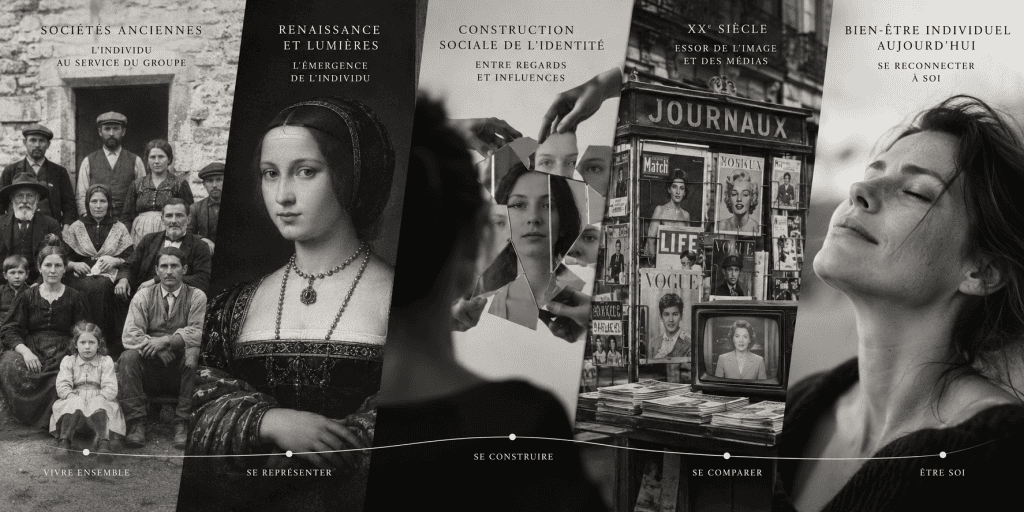
Today we talk about personal well-being, self-esteem, personal development. But this attention to the individual and to what he feels is actually very recent in human history. For centuries, the person was first thought of as a simple working within a group — family, village, religion, nation — before being considered as an individual in his own right, with his own value and needs.
One has moved from an identity almost entirely defined by society to an increasing place left to the individual and his well-being.
In old societies: the individual at the service of the group
In most traditional societies — be it medieval Europe, many African, Asian or Amerindian societies — The person is first defined by his place in a broader whole: his family, his clan, his occupation, his religion. We don't really wonder « Who am I, as a single individual? », but rather « What is my role, my role in this group? ».
This is no coincidence: in these societies survival depends directly on the solidarity of the group. An isolated individual is far less likely to leave alone. Personal identity therefore naturally goes into the background, behind collective identity.
The progressive birth of the individual (Renaissance and Lights)
In Europe, an important turning point is emerging from the Renaissance (XV-XVIth centuries), and especially in the century of Lights (XVIII century). The thinkers of this era are beginning to emphasize the idea that each person has his own reason, a self-consciousness, and therefore a value as an individual. — regardless of birth or social role.
It's the beginning of a background movement that we call theIndividualism : the idea that the person exists and counts as such, and not only through the group to which he belongs. This movement will accelerate with the French Revolution and the idea of individual rights, then throughout the 19th and 20th centuries.
The social construction of identity
Even when the individual begins to be recognized for himself, one thing remains true: you never build yourself completely alone. What one thinks of oneself is largely shaped by the eyes of others — family, school, friends, later work and society as a whole.
Sociologists call this the social construction of identity : the idea that our image of ourselves is not something fixed and given to birth, but something that is built, little by little, through our relationships and the messages that society sends us on what is valued or not. For example, the same person may feel confident in a context where they are valued, and lose confidence in another context where they are judged or excluded. The self-image is therefore never completely independent of the outside look — even if, over time, you also learn to untie it.
The 20th Century: Appearance as a New Social Issue
With the rise of photography, cinema and then television in the 20th century, a new phenomenon emerges: one compares more and more with images. In the past, people in their village or neighbourhood were more like each other. Gradually, we start to compare with faces seen in magazines, then on television, and finally on smartphone screens.
This change has a real impact on the self-image: personal esteem no longer depends solely on the eyes of relatives we know, but also on standards broadcast on a very large scale, sometimes far removed from the daily reality of people. This explains why the issue of self-image is so present in the current discussions.
A recent awareness: individual well-being counts
It is really only from the second half of the 20th century, and especially since the 1990s-2000, that the psychological well-being of the individual becomes a subject recognized and taken seriously, including outside the medical circle. Positive psychology, personal development, attention to mental health at work or school: all this is very recent in human history.
This evolution reflects a profound change of mentality: one no longer considers only the individual as someone who must fulfil a social role (worker, parent, citizen), but also as a person who has the right to feel well, to be listened to, and to take care of his own inner balance. It is a fairly recent reversal compared to entire centuries where individual feelings passed largely after duty towards the group.
What to remember
The history of self-perception is that of a long shift: from an individual almost entirely defined by his or her role in society, to a person recognized for himself or herself, with his or her own value and well-being. This shift is neither finished nor frozen: still today, everyone navigates between what society expects of him and what he really feels inside.
Understanding this story helps to take a step back from our own doubts or insecurities: much of what we feel about ourselves is also the result of a long social and historical construction — which, in itself, is already a way of releasing some of it.